
Belmont County residents and property owners can access a wide range of auditor forms for property, tax, and official applications. This includes property tax forms, homestead exemption forms, and other application forms that Belmont County, Ohio, uses to manage local records efficiently. Each form is structured to simplify submissions and reduce processing errors, helping users complete their filings accurately and quickly. Residents can download forms in PDF or digital formats, while office assistance is available for clarification on complex submissions. Timely use of these forms ensures property assessments and tax applications are processed without delays.
The Belmont County Auditor’s office offers forms for both individuals and businesses, covering parcel records requests, tax adjustments, and permit applications. Using the correct form supports accurate recordkeeping and maintains compliance with county requirements. Many forms include clear instructions, checklists, and submission deadlines to prevent common errors. These resources also allow property owners to manage ownership transfers, exemptions, and financial reporting effectively. Regular updates to forms reflect changes in Ohio tax law and county policies, ensuring residents always have the most current resources at hand.
How to Access Belmont County Auditor Forms
Residents and property owners in Belmont County can easily download auditor forms directly from the county’s official website. These forms cover property, tax, and other auditor-related services and are ready for online submission. Accessing forms in Belmont County, Ohio, is straightforward. The county provides official auditor forms in PDF format, which can be downloaded and printed for convenience. Users can start by visiting the Belmont County Auditor’s website, then navigating to the “Forms & Applications” section. Here, forms are organized by category, making it simple to locate exactly what is needed, such as property transfer forms, exemption requests, or parcel information requests.
To download forms:
- Open the official website: https://belmontcountyauditor.org/forms
- Go to the Forms & Applications page.
- Select the category of the form required.
- Click the PDF link to view or download the document.
- Print or fill out digitally if the form supports electronic completion.
Once completed, many forms can be submitted via mail, in-person delivery, or online upload, depending on the instructions provided on each form. Users should ensure all required fields are filled accurately to avoid delays in processing.
Agricultural Use Applications
Belmont County landowners seeking a farmland tax reduction may qualify for CAUV agricultural valuation through specific applications. These forms help property owners place land in agricultural districts, apply for CAUV, renew CAUV status, or defer recoupment charges. Proper use of these applications can reduce property taxes while preserving farmland. Each form—Form 11, DTE 109, DTE 109A, and DTE 115—serves a distinct purpose in the process, from initial placement to ongoing compliance.
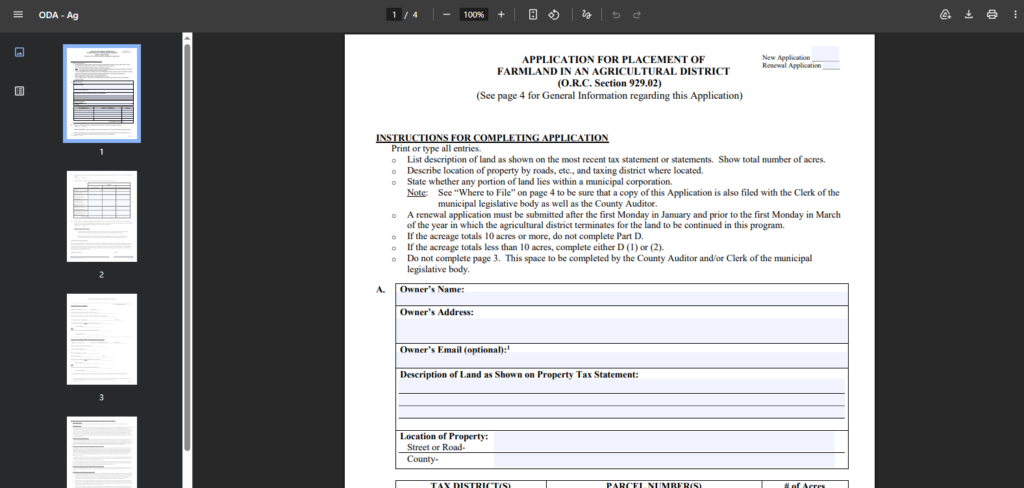
Form 11 – Placement in Agricultural District
Form 11 is used to enroll eligible farmland in an agricultural district, which is the first step for landowners seeking CAUV benefits.
Eligibility:
- https://belmontcountyauditor.org/api/Media?p=Form%2011%20-%20Application%20for%20Placement%20of%20Farmland%20in%20an%20Agricultural%20District.pdf
- Land must be actively used for farming or agricultural purposes.
- Minimum acreage requirements may apply depending on crop or livestock type.
Filing Process:
- Complete Form 11 with property details and owner information.
- Submit to the Belmont County Auditor’s office by the designated deadline, usually April 1.
- The county reviews the application and notifies owners of district acceptance.
Being in an agricultural district can make landowners eligible for CAUV agricultural valuation, helping reduce property tax burdens while protecting farmland.
DTE 109 – Initial CAUV Application
DTE 109 allows landowners to request a current agricultural use valuation for eligible farmland. This form calculates taxes based on the land’s productive capacity rather than market value.
Instructions and Requirements:
- https://belmontcountyauditor.org/api/Media?p=Forms/DTE%20109.pdf
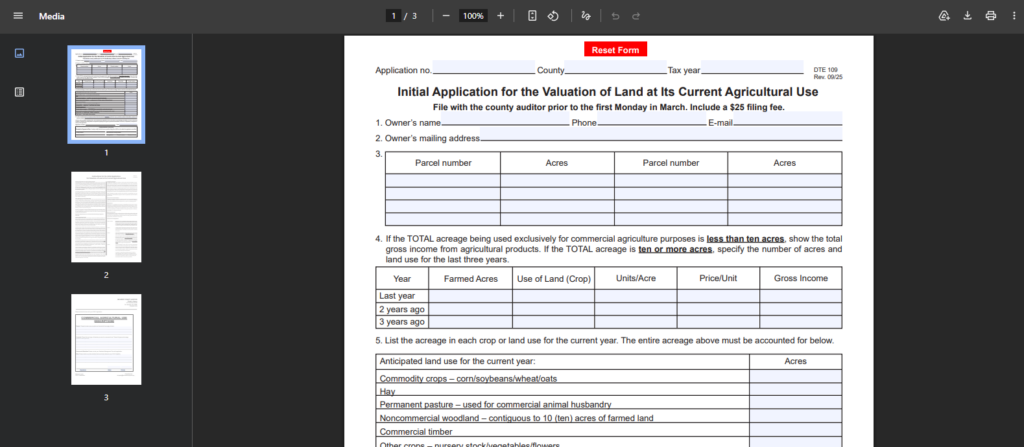
- Provide accurate acreage, soil type, and crop or livestock information.
- Submit supporting documents showing active agricultural use.
- Ensure filing by the annual deadline to avoid delays in tax adjustments.
Approval of DTE 109 may result in substantial farmland tax savings, reflecting lower CAUV valuation instead of higher market-based property assessments.
DTE 109A – CAUV Renewal
DTE 109A is used for CAUV renewal, ensuring continued tax benefits each year.
Renewal Process:
- https://belmontcountyauditor.org/api/Media?p=Documents/DTE%20109A%20-%20Current%20Agricultural%20Use%20Valuation%20Renewal%20Application.pdf
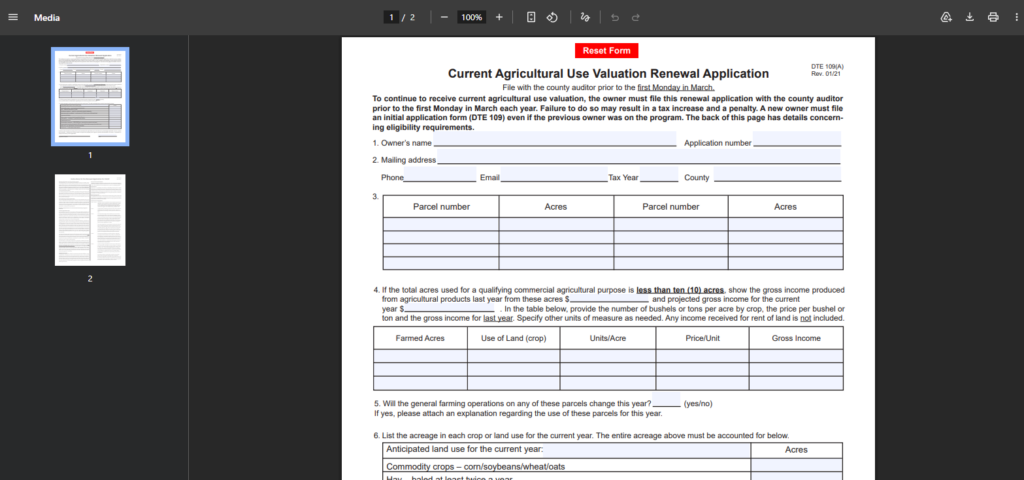
- Submit updated information about farm use and ownership.
- Verify any changes in acreage or agricultural activity.
- File before the established deadline, typically March 31, to maintain uninterrupted benefits.
Renewing on time ensures ongoing eligibility for farmland tax reduction and compliance with state regulations. Late or incomplete renewals may result in reassessment at full market value.
DTE 115 – Recoupment Charge Deferral
DTE 115 allows landowners to defer recoupment charges, which are taxes owed when farmland is removed from agricultural use before the minimum holding period.
Application Purpose:
- https://belmontcountyauditor.org/api/Media?p=Documents/DTE%20115%20-%20Application%20to%20Defer%20Recoupment%20Charge%20on%20Land%20Converted%20from%20Agricultural%20Use.pdf
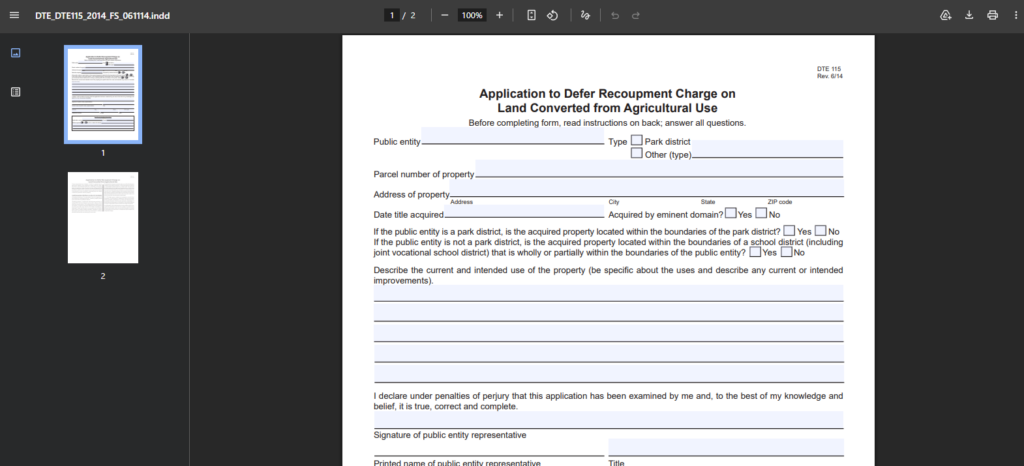
- Provides financial relief by delaying payment of recoupment taxes.
- Helps landowners manage cash flow without losing eligibility for future CAUV benefits.
How to Defer:
- Complete Form DTE 115 with details of the property and reason for deferral.
- Submit to the Belmont County Auditor’s office for approval.
- Follow the payment schedule set by the county once deferred.
Using DTE 115 strategically can help landowners maintain CAUV benefits while transitioning property use or managing unexpected financial obligations.
Belmont County Board of Revision Forms
The Belmont County Board of Revision reviews complaints about property tax valuations in Belmont County. Property owners can file official complaint forms to challenge an assessed value or request a different type of assessment decision. The Belmont County Board of Revision handles formal real property appeal cases each year. These filings help property owners dispute assessed values used for property tax appeals in Belmont County cases. Most complaints rely on standardized Ohio forms such as DTE 1, DTE 1M, and DTE 2. Each form addresses a specific type of valuation issue.
A complaint must be submitted within the filing window set by Ohio law, typically early in the tax year. After submission, the board reviews evidence and may schedule a hearing. Property owners often attach documents like comparable sales data, appraisal reports, photos, or repair estimates to support a valuation challenge. Below are the primary complaint form options used for Board of Revision cases.
DTE 1 – Real Property Valuation Complaint
DTE 1 is the standard form used to dispute the market value of real estate. Property owners file it when they believe their parcel assessment is too high or inaccurate. This real property appeal applies to residential, commercial, and vacant land parcels listed in county property records.
Filing points include:
- https://belmontcountyauditor.org/api/Media?p=DTE%201%20-%20Complaint%20Against%20the%20Valuation%20of%20Real%20Property.pdf
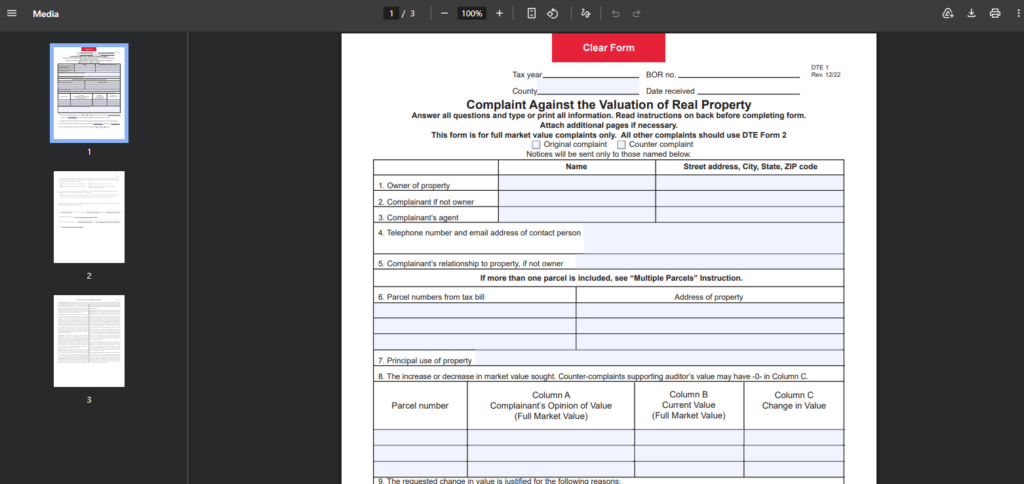
- Identify the parcel number from the county tax list.
- Provide the current assessed value and the requested value.
- State the reason for the valuation dispute.
- Attach supporting proof, such as recent property sales or appraisals.
Once filed, the Belmont County Board of Revision reviews the complaint and may schedule a hearing. During the hearing, the property owner or representative presents evidence supporting the requested value change.
DTE 1M – Manufactured Home Valuation Complaint
DTE 1M applies to manufactured or mobile homes taxed as personal property. Owners who believe the tax value is incorrect can submit this form.
The filing process usually follows these steps:
- https://belmontcountyauditor.org/api/Media?p=DTE%201M%20-%20Complaint%20Against%20the%20Valuation%20of%20a%20Manufactured%20or%20Mobile%20Home%20Taxed%20Like%20Real%20Property.pdf
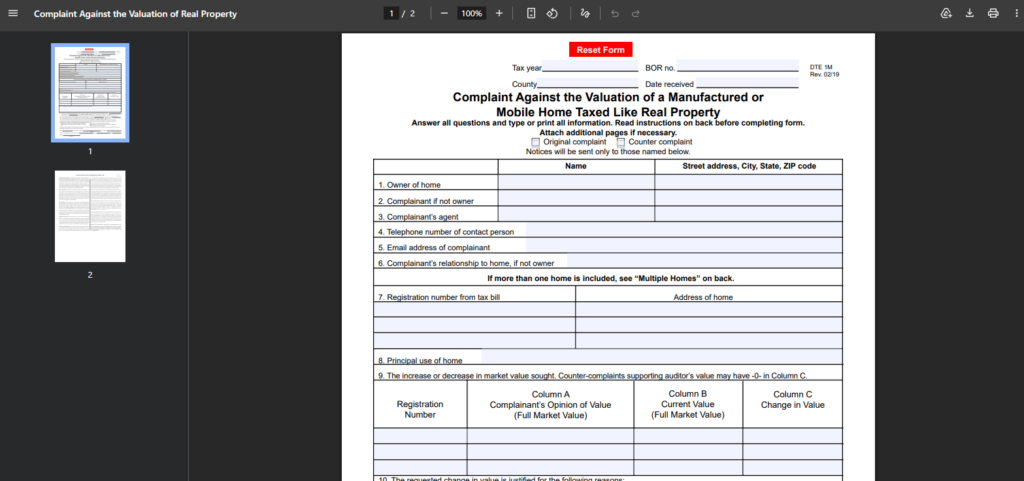
- Locate the manufactured home tax account number.
- Enter the assessed value listed on the county tax record.
- Provide the corrected value requested in the complaint.
- Add proof such as purchase documents, depreciation details, or comparable manufactured home sales.
- Submit the completed form to the county auditor or Board of Revision office.
A hearing may be scheduled if the board needs more details about the valuation challenge. Decisions are issued after reviewing submitted records and testimony.
DTE 2 – Assessment Other Than Market Value
DTE 2 handles complaints that involve an assessment issue other than property market value. This form often applies when a property classification or tax status appears incorrect.
- https://belmontcountyauditor.org/api/Media?p=DTE%202%20-%20Complaint%20Against%20the%20Assessment%20of%20Real%20Property%20Other%20than%20Market%20Value.pdf
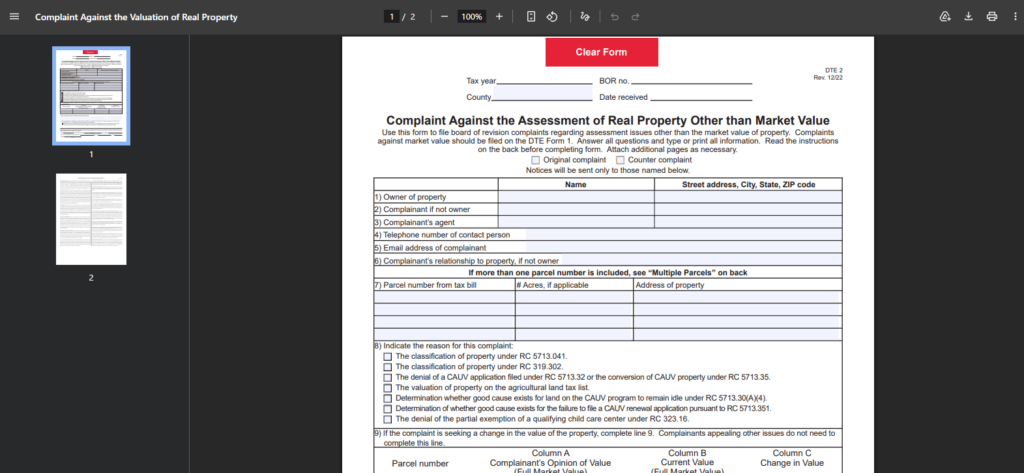
Common situations that use DTE 2 include:
| Situation | Example Issue |
|---|---|
| Property classification | Residential property recorded as commercial |
| Exemption status | Incorrect tax exemption removal |
| Assessment errors | Duplicate or incorrect tax entry |
The complaint must describe the issue clearly and include documentation supporting the claim. After review, the Belmont County Board of Revision decides whether to correct the tax record or assessment.
Budgetary Forms
Belmont County auditor forms related to budgeting help manage county funds, vendor payments, and financial requests. These financial forms support tasks such as setting up electronic payments and requesting unclaimed funds held by https://belmontcountyauditor.org/api/Media?p=Forms/ACH%20Authorization%20Form.pdf the county. Budgetary paperwork supports clear record-keeping for public money. The Belmont County Auditor’s Office uses these forms to document financial activity, track county funds, and process payment instructions.
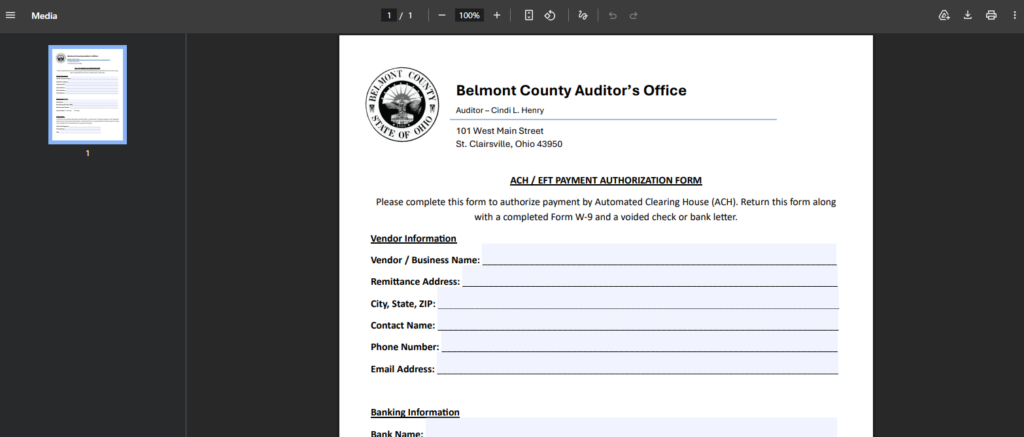
Residents, vendors, and organizations may use them during financial transactions with county departments. These financial forms help record payment details, confirm authorization, and submit claims connected to county accounts. Each form includes required fields such as contact details, payment information, and request statements. Accurate entries help the auditor’s staff review requests and process payments faster.
Common Belmont County Budgetary Forms
Several Belmont County auditor forms relate directly to county budget activity and financial requests.
| Form Name | Purpose | Who Uses It |
|---|---|---|
| ACH Authorization Form | Allows electronic transfer of county payments into a bank account | Vendors, contractors, and payment recipients |
| Unclaimed Funds Request Form | Requests funds held by the county that belong to a person or business | Residents, heirs, or organizations |
| Financial Request or Budget Forms | Used by departments to record payment or budget adjustments | County offices and finance staff |
- ACH Authorization Form
This form sets up direct deposit for county payments. Vendors who receive payments from Belmont County submit bank details and authorization signatures. After approval, the county sends payments through Automated Clearing House transfers. - Unclaimed Funds Request Form
Unclaimed funds may appear when payments remain uncollected. Property owners, heirs, or businesses submit a request form along with proof of ownership. The auditor’s office reviews the documents before releasing the funds. - Department Financial Forms
County departments submit budget or financial forms to track spending from allocated funds. These documents record payment approvals, department budgets, and account references within the county finance system.
Damaged and Destroyed Property Forms
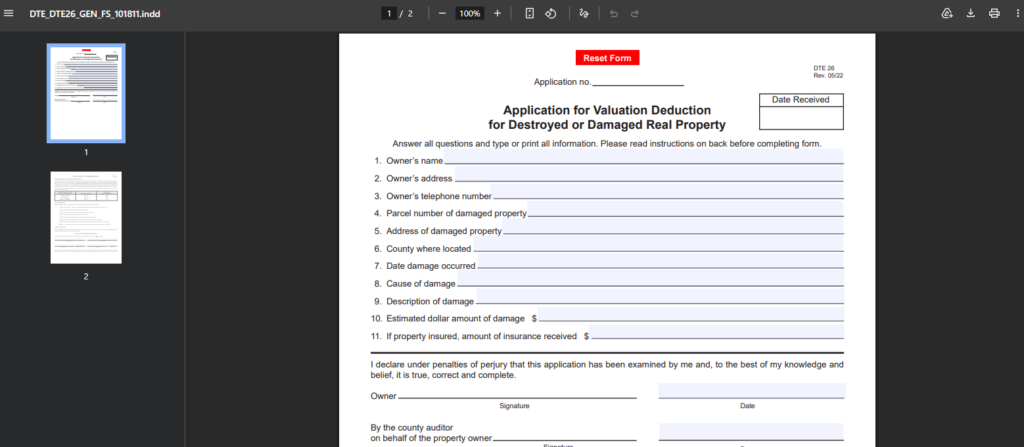
Property owners can request tax relief after major damage or loss by filing auditor property forms with the county. The DTE 26 destroyed property application reports damage so the tax value can reflect the property’s current condition. Property damage from fire, storms, demolition, or structural failure may change the taxable value of real estate. The Belmont County Auditor reviews these reports and updates the property record after a valid claim. The DTE 26 form, created by the Ohio Department of Taxation, serves as the official document used across Ohio counties.
DTE 26 Destroyed Property Application
The DTE 26 supports a damaged property claim or destroyed property application when a structure loses value during the tax year. Owners file the form with the county auditor soon after https://belmontcountyauditor.org/api/Media?p=DTE%2026%20-%20Application%20for%20Destroyed%20or%20Damaged%20Real%20Property.pdf the event, so the office can review the loss.
Common situations that qualify include:
- Fire damage affecting part or all of a building
- Storm events such as wind, tornado, or flooding
- Structural collapse or major safety damage
- Demolition of a building during the tax year
Once filed, the auditor’s office reviews the claim and inspects the parcel if needed. The office may adjust the property’s taxable value for the period after the damage occurred.
Homestead Exemption Forms
Homestead exemption forms allow eligible property owners in Belmont County to request a reduction in property taxes. These forms help seniors, disabled residents, veterans, and surviving spouses claim tax relief on their primary residence. Property tax relief plays a key role for homeowners who live on a fixed income or face service-related disabilities. Through the homestead exemption program, qualified residents can lower the taxable value of their home. This reduction decreases the total property tax owed each year.
The Belmont County Auditor forms used for this benefit belong to the DTE 105 series. Each form applies to a different eligibility group, such as senior citizens, disabled homeowners, or surviving spouses of service members. Many residents search for homestead exemption forms during tax season or after retirement. Filing the correct form allows the county auditor to review eligibility and apply the proper tax reduction.
The Homestead Exemptions
A homestead exemption reduces the taxable value of an owner-occupied property. In many cases, the program removes a set dollar amount from the home’s value before property taxes are calculated.
For example, a qualifying homeowner may receive a reduction that lowers the taxable value of their residence. The local tax rate then applies to the reduced amount, which leads to smaller annual tax bills. Eligibility rules often focus on age, disability status, or military service. The property must serve as the owner’s primary residence, often called a homestead property.
Common eligibility groups include:
- Senior citizen homestead applicants aged 65 or older
- Disabled homeowners with a qualifying disability determination
- Disabled veteran homestead applicants with service-related disability ratings
- Surviving spouse exemption applicants whose spouse qualified for the program
Typical benefits connected to these exemptions include:
| Benefit Type | Description |
|---|---|
| Taxable Value Reduction | A fixed portion of home value removed from taxation |
| Long-Term Tax Relief | Reduced property taxes for eligible homeowners |
| Stability for Fixed Income | Helps seniors and disabled residents manage housing costs |
Many states and counties require annual verification or initial application deadlines. Filing early helps the auditor’s office review documents before the next tax cycle begins.
Forms for Seniors, Disabled, Veterans, Surviving Spouses
The DTE 105 series includes several forms used to request homestead tax relief. Each form targets a specific eligibility category.
Below are the most common homestead exemption forms used by property owners.
- 1. DTE 105A – Homestead Exemption Application
- https://belmontcountyauditor.org/api/Media?p=DTE%20105A%20-%20Homestead%20Exemption%20Application%20for%20Senior%20Citizens.pdf
- Used by senior citizen homeowners
- Applicant typically must be 65 years or older
- Requires property ownership and residency verification
- 2. DTE 105E – Disabled Veteran Homestead Exemption
- https://belmontcountyauditor.org/api/Media?p=DTE%20105E%20-%20Certificate%20of%20Disability%20for%20the%20Homestead%20Exemption.pdf
- For veterans with qualifying service-related disability ratings
- Requires documentation from the U.S. Department of Veterans Affairs
- 3. DTE 105G – Disabled Person Homestead Application
- https://belmontcountyauditor.org/api/Media?p=DTE%20105G%20-%20Addendum%20to%20the%20Homestead%20Exemption%20Application.pdf
- For homeowners with a permanent disability
- Requires disability certification from an authorized agency
- 4. DTE 105H – Continuing Homestead Eligibility
- https://belmontcountyauditor.org/api/Media?p=DTE%20105H%20-%20Addendum%20to%20the%20Homestead%20Exemption%20Application%20For%20Senior%20Citizens,%20Disabled%20Persons%20and%20Surviving%20Spouses.pdf
- Used to confirm that a previously approved homeowner still meets program rules
- 5. DTE 105I – Surviving Spouse Homestead Application
- https://belmontcountyauditor.org/api/Media?p=DTE%20105I%20-%20Homestead%20Exemption%20Application%20For%20Disabled%20Veterans%20and%20Surviving.pdf
- Filed by the surviving spouse of a qualified veteran or homeowner
- Requires proof of marriage and prior eligibility
- 6. DTE 105K – Homestead Late Application
- https://belmontcountyauditor.org/api/Media?p=DTE%20105K%20-%20Homestead%20Exemption%20Application%20for%20Surviving%20Spouses%20of%20Public%20Service%20Officers%20Killed%20in%20the%20Line%20of%20Duty.pdf
- Used when the original deadline passed
- Applicant must provide a valid reason for the delayed filing
Property owners usually submit these forms to the Belmont County Auditor’s Office along with supporting records such as:
- Proof of age or disability
- Property ownership records
- Veteran service documentation
- Residency confirmation
Clear documentation speeds up application review. Once approved, the homestead exemption applies to the property tax calculation for the eligible residence.
Manufactured Home Forms
Manufactured home registration in Belmont County requires specific tax and ownership forms. These documents record ownership changes, tax status, and possible conveyance fee exemptions for mobile homes. The Belmont County Auditor manages manufactured home records and property tax details for mobile or manufactured housing. Owners must file certain forms issued by the Ohio Department of Taxation to register, transfer, or update the tax status of a manufactured home. These forms help the county track ownership, confirm tax payments, and record exemptions linked to property transfers. Manufactured homes are taxed as real property or personal property based on how the home sits on the land. For that reason, accurate paperwork supports tax records and keeps county files current. Mobile home tax forms give the auditor clear proof of ownership, tax liability, and exemption eligibility.
Manufactured Home Tax Forms
Several state forms support manufactured home registration and tax processing. Each form serves a different role in county tax records.
| Form | Purpose | Common Use |
|---|---|---|
| DTE 41 | Manufactured Home Conveyance Fee Statement | Filed during ownership transfer |
| DTE 100M | Manufactured Home Homestead Exemption Application | Used by qualifying homeowners |
| DTE 100M(EX) | Homestead Exemption for Disabled Veterans | Provides tax relief for eligible applicants |
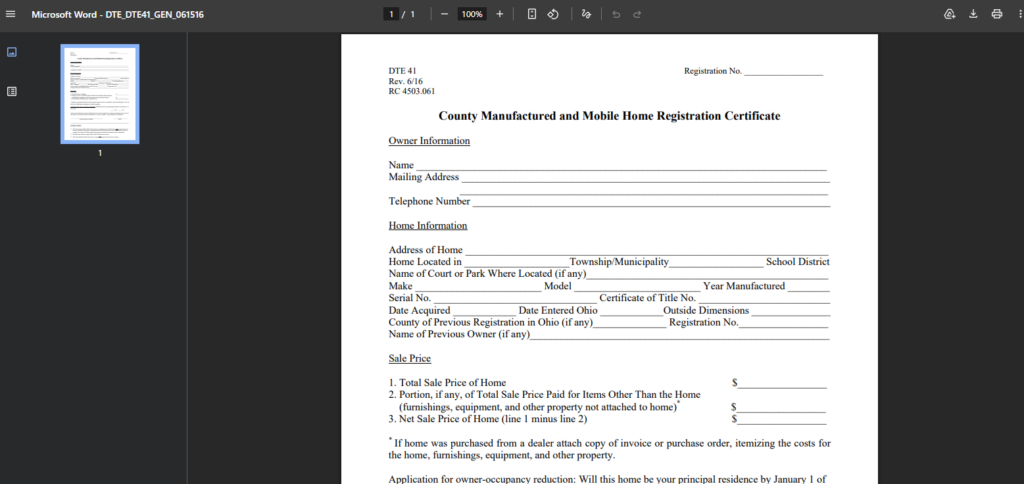
- DTE 41 records the transfer of a manufactured home title and calculates any conveyance fee owed. County officials review this form during ownership changes.
- https://belmontcountyauditor.org/api/Media?p=DTE%2041%20-%20Manufactured%20Home%20Registration.pdf
- DTE 100M allows qualified homeowners to claim a homestead reduction on manufactured home property taxes. Senior citizens and disabled homeowners often file this form.
- DTE 100M(EX) applies to disabled veterans who qualify for a property tax exemption on a manufactured home.
Owner Occupancy Credit
Owner occupancy credit offers a 2.5% tax reduction on the assessed value of a home used as the owner’s primary residence. In Belmont County, property owners apply using Form DTE 105C, filed with the county auditor, to claim this primary residence credit.
What the Owner Occupancy Credit Means for Homeowners
The owner occupancy credit lowers property tax costs for residents who live in their homes as their main residence. The credit reduces the taxable value of a qualifying property by 2.5%, which lowers the final tax bill charged by the county. Property owners must occupy the home as their primary residence on January 1 of the tax year. Rental properties, vacation homes, and commercial buildings do not qualify for this tax reduction.
Common benefits include:
- Lower annual property taxes
- Recognition of a property as a primary residence
- Long-term tax savings for homeowners
Applying With Form DTE 105C
Residents request the credit by submitting Form DTE 105C to the Belmont County Auditor’s Office. The form confirms that the property serves as the owner’s principal residence.
Basic application details
| Requirement | Description |
|---|---|
| Form | DTE 105C |
| Purpose | Claim the 2.5% tax reduction |
| Eligibility | Property used as the owner’s primary residence |
| Filing location | Belmont County Auditor’s Office |
Applications typically include the property owner’s name, parcel number, and proof that the home serves as the principal residence.
Property Tax Exemption Forms
Property tax exemption forms help eligible property owners request reduced or waived property taxes through the Belmont County Auditor’s Office. These forms cover programs such as veterans’ exemption, tax incentive programs, and remission of penalties. Property owners in Belmont County may qualify for tax relief through several official forms. Each form supports a different type of property tax exemption or tax relief request. Filing the correct form helps the county review eligibility and apply the proper tax reduction to the property record.
These applications usually require basic details such as the parcel number, property owner information, and supporting documents. Many requests must be submitted before specific deadlines so the exemption can apply to the current tax year.
Property Tax Exemption Forms Used in Belmont County
Several official forms allow property owners to request different types of tax relief. Each serves a distinct purpose within the county property tax system.
| Form Number | Purpose | Who Should File |
|---|---|---|
| DTE 23 | Application for Remission of Real Property Taxes and Penalties | Owners requesting removal of penalties or unpaid tax charges |
| DTE 23A | Application for Remission of Manufactured Home Taxes | Owners of manufactured or mobile homes seeking penalty relief |
| DTE 23B | Application for Late Filing Penalty Remission | Property owners who missed filing deadlines for exemptions |
| DTE 23N | Veterans exemption application | Qualified disabled veterans seeking property tax reduction |
| DTE 23V | Application linked to the tax incentive program benefits | Property owners participating in approved local incentive programs |
| DTE 24 | Application for Real Property Tax Exemption | Non-profit groups or qualifying property uses requesting exemption |
Each form helps the county review eligibility for tax adjustments. Filing the correct application reduces processing delays and supports accurate property tax records.
Real Property Transfers and Conveyances
Real property transfer forms record the legal change of property ownership in Belmont County. These documents report sale details, parcel data, conveyance fee statements, and tax status before a deed is recorded with the county. Property owners, title companies, and legal representatives file these forms with the Belmont County Auditor before a deed enters the county record system. The office reviews ownership details, parcel numbers, tax status, and acreage changes. This review confirms that the conveyance fee statement and property tax information match the deed being submitted.
Real estate transfers often involve farmland, residential parcels, or homestead property. Each situation may require a different form of a worksheet. Clear documentation helps the auditor verify parcel data and maintain accurate county tax records.
Real Property Transfer Forms
Several real property transfer forms appear during property conveyance in Belmont County. Each form serves a specific purpose in the transfer process.
| Form | Purpose |
|---|---|
| DTE 100 | Standard conveyance fee statement used for most real estate transfers. |
| DTE 100EX | Used when a transfer qualifies for a conveyance fee exemption. |
| DTE 101 | Statement confirming the value of real property when the sale price requires clarification. |
| DTE 102 | Statement supporting exempt transfers such as family conveyances or government transfers. |
These forms provide key data such as:
- Parcel identification number
- Property sale price
- Transfer date
- Names of grantor and grantee
- Conveyance fee calculations
Accurate information helps county staff confirm that property taxes remain correctly assigned after the transfer.
Supporting Worksheets and Special Situations
Some transactions require extra documents before approval. These worksheets clarify land changes or help process deed submissions.
Common supporting documents include:
- Deed Drop-Off Form: Used when documents are submitted without waiting for in-office processing.
- Split Acreage Worksheet: Records land division details when a parcel splits into separate tracts.
- CAUV Property Conveyance documentation: Used for farmland enrolled in the Current Agricultural Use Value program.
For example, farmland transfers may need proof that CAUV property conveyance rules remain satisfied after ownership changes. A parcel split may require updated acreage figures and tax calculations.
How to Submit Your Forms
Submitting a Belmont County auditor form involves choosing a method that fits the applicant’s situation. Most forms reach the office through online submission, mail delivery, or in-person drop-off. A clear process helps prevent delays and missing paperwork. Each applicant should review the form, attach the required records, and send them through the correct channel listed by the Belmont County Auditor’s office.
Steps Auditor Form Submission Process
A simple checklist helps applicants complete the auditor form submission process with fewer issues. Follow these steps before sending the form:
- Fill out the form completely
Enter property details, parcel numbers, and contact information. Double-check spelling and numbers. - Attach supporting records
Some applications require proof, such as identification, property deeds, or exemption documents. - Sign and date the form
Unsigned forms often cause delays in processing. - Choose a submission method
Applicants can submit forms through the options below.
Submission Methods
| Method | How It Works | Best For |
|---|---|---|
| Online submission | Upload completed forms through the county website portal if the form supports digital filing. | Fast processing |
| Mailing instructions | Send the printed form and documents to the Belmont County Auditor’s office mailing address. | Applicants outside the county |
| In-person delivery | Drop off the form at the county auditor office during business hours. |
FAQs About Belmont County Auditor Forms
Residents often have questions about Belmont County Auditor forms, including how to submit them, how long processing takes, and how to appeal property valuations.
Can I submit forms online?
Some Belmont County Auditor forms can be submitted online, but others require a printed signature. Online submission is usually accepted for forms that do not need notarization or additional documentation. Residents can download forms from the county site and submit via email, mail, or in person. For complex filings, like ownership updates or exemptions, physical delivery may be required. Checking instructions on each form ensures proper submission.
What is the processing time for CAUV forms?
CAUV forms typically take several weeks to process after submission. The auditor’s office reviews land use, acreage, and eligibility before approval. Processing time depends on the number of applications and verification checks. Staff confirms the property meets the Ohio CAUV program standards before updating the tax record. Applicants usually receive confirmation once the value change is applied. Knowing expected timelines helps plan property tax matters.
How do I appeal my property tax valuation?
Property owners can file a valuation complaint form to appeal an inaccurate assessment. The form requires parcel details, the owner’s estimated value, and supporting documents like appraisals or sales data. The county Board of Revision reviews the complaint and may schedule a hearing. During the hearing, owners can present evidence about market value. After the review, the board issues a decision and updates the property record accordingly.
What forms are needed for a homestead exemption?
To apply for a homestead exemption, property owners must complete the designated exemption form provided by the Belmont County Auditor. The form typically requests proof of ownership, residency, and any qualifying status, such as senior citizen or disability. Applicants must submit the form before the county’s deadline to reduce property taxes. Supporting documents, like a driver’s license or disability certification, are often required. Filing early ensures the exemption is applied for the correct tax year.
How can I check the status of my submitted forms?
Residents can check the status of Belmont County Auditor forms by contacting the auditor’s office directly via phone, email, or in-person visit. Some submissions may be tracked through the county’s online services if digital filing was used. Staff can provide updates on processing time, verification steps, or missing documentation. Knowing the status helps avoid delays and ensures forms are properly recorded. Keeping a copy of the submitted form and confirmation receipt is recommended for reference.