
Residents and businesses in Belmont County hold a statutory right to obtain official documents from county offices. The county rigorously adheres to the Ohio Public Records Act, offering transparent access to government records, including property reports, meeting minutes, and administrative files. Each request can be submitted through the official Records Request Form PDF, guaranteeing accurate processing and timely responses. This structured approach allows citizens to obtain verified information while maintaining compliance with state regulations.
Belmont County maintains an organized repository of records to fulfill requests efficiently. Citizens can request public record access for diverse documents such as land parcel data, financial reports, permits, and licenses. The offices review each submission promptly and provide copies electronically or in print. Detailed information, like parcel numbers or specific dates, helps ensure rapid processing. By following this formal procedure, individuals and organizations receive authentic, state-compliant documents while supporting transparency in county operations.
What Are Public Records in Belmont County?
Public records in Belmont County are official documents and information maintained by local government agencies that are available for inspection or request. These records cover a wide range of topics, from property ownership to administrative activities, and their disclosure is regulated by state law.
Belmont County public records provide transparency and allow residents, researchers, and businesses to review public information for various purposes. These records can include property datasets showing parcel boundaries and ownership, financial reports, and administrative filings. The Ohio Public Records Act requires government offices to maintain and provide such records unless specifically exempted for privacy or security reasons.
Types of Public Records Available
Residents and businesses can request several types of records from Belmont County offices, including:
- Property Records: Details about land parcels, property ownership, tax assessments, and zoning information. These datasets help verify ownership and check legal property boundaries.
- Financial Records: Budgets, spending reports, contracts, and county revenue information. These records provide insight into local government expenditures and financial planning.
- Administrative Records: Meeting minutes, resolutions, ordinances, permits, and licenses. Administrative records reveal decisions, regulations, and approvals made by county authorities.
Each category of records provides a snapshot of public operations and contributes to transparency in government activities.
Basis for Records Disclosure
The Ohio Public Records Act (ORC §149.43) sets the legal foundation for Belmont County public records. It ensures that citizens can request access to public information while defining exemptions to protect sensitive data. Public offices must respond promptly to requests and may provide records in electronic or physical formats. Requests should clearly identify the type of record needed to facilitate efficient processing.
How to Request Public Records
Requesting Belmont County public records is straightforward and can be done through in-person visits, mail, or email. The county provides a simple Records Request Form to streamline the process for residents and businesses.
Submitting a public records request begins with filling https://belmontcountyhealth.com/Forms/EnvironmentalHealth/Records-Request-and-Instructions.pdf out the Belmont County public records request form, which collects essential details such as the requester’s name, contact information, and the specific records needed. This structured approach ensures that the county staff can process requests accurately and efficiently.
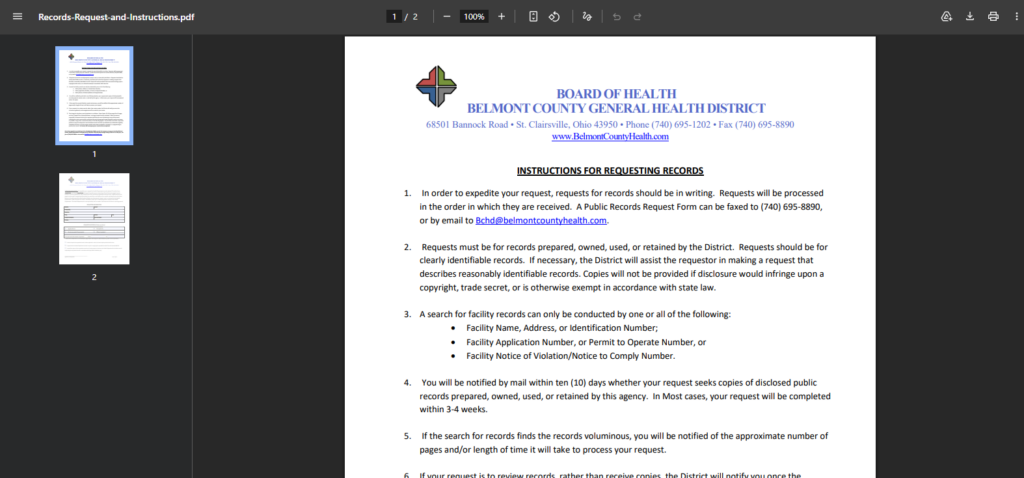
Steps Process for Submitting a Request
To submit a records request, follow these steps:
- Download the Records Request Form
- Visit the Belmont County website and download the Records Request Form PDF.
- Keep a copy for your records after filling it out.
- Complete the Form
- Provide your full name, email, mailing address, and phone number.
- Clearly describe the records you are requesting. Be specific to avoid delays.
- Submit the Request
- In-person: Bring the completed form to the county office during business hours.
- Mail: Send the form to the appropriate county department address listed on the form.
- Email: Scan the completed form and attach it to an email, ensuring the subject line clearly states “Public Records Request.”
- Confirmation and Follow-Up
- The county office typically acknowledges receipt of requests via email or phone.
- Keep the confirmation for reference in case additional details or fees are required.
Request Form Details
The records request form is designed to capture all necessary information for processing public records efficiently. Each field should be completed clearly to avoid ambiguity.
Fields include:
- Full name and contact details
- Specific records being requested (dates, names, document type)
- Preferred method of delivery (email, mail, or in-person pickup)
Accurate form completion:
- Use precise descriptions for records. Avoid vague terms like “all documents” without further clarification.
- Double-check contact information to ensure the county can reach the requester if needed.
- Optional fields can be used to indicate urgency or special instructions, though these are not required.
Sample excerpt (non-official example):
- Requester Name: Jane Doe
- Address: 123 Main Street, Belmont, OH 43718
- Records Requested: Property deed records for 456 Elm Street (Jan 2020 – Dec 2022)
- Delivery Method: Email preferred
Following the submission reduces the risk of delays and ensures Belmont County staff can locate the requested documents quickly. Using the official form and completing it correctly provides a smoother, more reliable experience for everyone.
Response Time and Processing
Belmont County typically processes public record requests within a reasonable timeframe, depending on the volume and type of records requested. Requesters can expect clear communication from the office regarding the estimated timeline and any delays that may occur.
Average Timeline Based on Volume
The response estimate for public record requests varies widely based on the number of records, their format, and whether a legal review is required. Small requests, such as a single document or basic record, often take 3–5 business days. Larger requests involving multiple files or extensive archives may take 2–4 weeks, especially if staff must review records for compliance with state laws before release.
Factors that influence the timeline include:
- Volume of records: Large datasets require more time to collect, review, and format.
- Record type: Certain records, such as legal filings or sensitive information, may require additional review.
- Staff availability: High request volume or limited staffing can affect processing speed.
By understanding these factors, requesters can form realistic expectations for receiving records.
What Constitutes “Reasonable Time”
A reasonable time refers to the period necessary for the office to process a request thoroughly without unnecessary delay. It balances prompt service with proper handling of documents, ensuring accuracy and compliance with legal standards.
In practice, the office considers a request reasonable when it accounts for:
- Legal review: Sensitive or confidential records undergo careful examination to protect privacy and comply with the law.
- Preparation and organization: Staff may need to extract, scan, or format documents for delivery.
- Volume adjustments: Larger requests are scheduled in a manner that prevents backlog or errors.
This approach ensures the requester receives complete, accurate, and legally appropriate records.
Communication and Updates
Belmont County maintains open lines of communication throughout the request process. The office often provides:
- Acknowledgment of receipt: Confirms the request has been received and is being reviewed.
- Progress updates: Notifies requesters of estimated completion dates or any delays.
- Delivery confirmation: Ensures records are sent securely via mail, email, or in-person pickup.
Requesters are encouraged to provide current contact information to receive timely updates. Clear communication helps manage expectations and reduces uncertainty.
Records That May Be Exempt
Some Belmont County records are considered exempt and may not be fully released to the public. Exempt records typically contain confidential or non-public information that requires legal review before disclosure.
Types of Exempt Records
Exempt records include those that state or federal law protects from public release.
Common categories include:
- Personal identifying information (Social Security numbers, bank account details)
- Law enforcement files under active investigation
- Medical or mental health records
- Juvenile court records
- Attorney-client or internal legal communications
These records are sensitive and often require redacted records to protect privacy while providing partial access.
Redaction Process
When a record contains exempt information, the county applies a redaction process to remove or obscure sensitive details.
Staff may:
- Black out or remove confidential sections
- Create a summary version of the record
- Include only information legally allowed for public release
Redaction ensures that users receive the information they request without exposing non-public information or violating privacy laws.
How Users Are Notified of Exemptions
Requesters are informed if a record is partially or fully exempt. Notification typically includes:
- Which sections have been redacted
- The legal authority for withholding information
- Any instructions for appeal or further review if users seek additional access
This communication helps users understand why certain details are unavailable and what steps can be taken to request clarification.
Legal Authority Citations
Belmont County follows state and federal laws to determine exemptions. Key references include:
- Ohio Revised Code Section 149.43: Public records exemptions
- Federal privacy regulations for medical, financial, or law enforcement records
- Internal county policies that align with these statutes
By citing the legal basis for exemptions, the county ensures transparency while maintaining compliance with privacy and confidentiality requirements.
Fees for Copies and Delivery
Belmont County charges modest fees for public records, covering both paper and digital copies. Most requests remain affordable, with the first 20 pages provided at no charge.
Current Fee Structure
The county sets public record fees to cover actual copying costs and delivery expenses. Paper copies cost $0.05 per page, keeping standard requests inexpensive. For digital formats, fees vary slightly depending on media type:
- CD-ROM: $1.00 per disc
- Postage: Actual cost depending on delivery method
- Duplication: Large files or specialized records may incur additional fees
This fee structure ensures that requesters pay only for what they receive, making it easier to plan.
Free Copies Limit
Belmont County allows up to 20 pages free for standard public record requests. This limit encourages transparency while covering administrative costs for larger requests. Requests exceeding 20 pages are charged at the standard $0.05 per page.
For example:
| Number of Pages | Fee |
|---|---|
| 15 pages | $0.00 (free) |
| 50 pages | $1.50 |
| 100 pages | $4.00 + any CD-ROM or postage costs if applicable |
Payment Methods Accepted
The county accepts several convenient payment methods to process fees efficiently:
- Cash
- Check (made payable to Belmont County Auditor)
- Money order
Online or card payments may be available for certain digital requests, depending on the department handling the record.
Example Scenarios: Paper vs Digital
- Paper Request: A resident requests 35 pages of property records. The first 20 pages are free, leaving 15 pages at $0.05 each. Total cost: $0.75, plus postage if mailed.
- Digital Request: A requester asks for a complete zoning map on CD-ROM. The CD costs $1.00, and if mailed, the postage fee is added. Duplication charges may apply for large or specialized files.
By keeping copying costs transparent and offering flexible delivery options, Belmont County ensures public records remain accessible without unnecessary expense. Users can plan requests according to their needs, whether for a few pages or larger document sets.
Common Issues & How to Avoid Them
Requests for Belmont County public records are sometimes denied due to vague or overbroad descriptions. Clear, specific requests significantly increase the chance of a successful response. One frequent cause of a records request issue is submitting an overbroad request. When a request lacks precise details—like a date range, specific document type, or case number—the office may be unable to identify which records to provide. Ambiguous language often leads staff to deny the request rather than risk releasing incorrect information.
Another reason for request denial is the incomplete or inaccurate identification of records. Without proper names, parcel numbers, or filing details, offices struggle to locate the correct files. This can be particularly true for historical records or complex case files, where multiple documents may match a general description.
How to Refine Requests
Refining a request improves the chances of approval and reduces delays. Consider these strategies:
- Specify exact dates: Narrow requests to specific years, months, or even days.
- Include identifiers: Names, parcel numbers, case numbers, or document codes help staff locate files quickly.
- Describe document type: Indicate whether the request is for deeds, maps, court filings, or property reports.
- Break large requests into smaller parts: Multiple concise requests often receive faster responses than one large, overbroad request.
- Use clear language: Avoid terms that could be interpreted in several ways.
Contact the Belmont County Auditor’s Office
The Belmont County Auditor’s Office can be reached by phone, email, or in person for public records requests and property information. Residents and visitors can connect directly with the office during regular business hours for assistance.
For those needing direct support, the Belmont County Auditor’s contact information includes:
- Address: 101 West Main Street, St. Clairsville, OH 43950
- Office Phone: (740) 699-2160
- Email: auditor@belmontcountyauditor.org
- Office Hours: Monday – Friday, 8:30 a.m. – 4:30 p.m.
Methods to Contact
Residents have multiple ways to reach the auditor’s office depending on their needs:
- Phone: Quick inquiries, appointment scheduling, and clarification on records.
- Email: Non-urgent questions or requests for digital documents. Include your name, parcel number, or property details to help staff respond efficiently.
- In-Person Visit: Ideal for reviewing property records, signing documents, or getting guidance on public records requests.
The office staff provides public assistance for property tax information, parcel maps, and document verification. For those visiting, a map embed can help locate the building easily, and on-site staff is available to assist with forms and inquiries.
(FAQs) About Public Records Request
Belmont County public records can be requested by anyone following the county’s official procedures. Response times and fees depend on the type of record and how the request is submitted. This FAQ provides answers to the most common questions, helping users complete requests efficiently.
How can someone request public records in Belmont County?
Anyone can submit a request form to the relevant county office to access public records. The form requires details like record type, date range, and contact information. Requests can be submitted by mail, email, or in person. Providing complete information reduces processing delays and ensures faster responses. Forms for property records are available in the Belmont County Auditor’s section.
Are there fees for obtaining records?
Most public records involve fees for copies or certifications. For example, birth and death certificates typically cost $15–$20, while property documents may charge $0.25 per page. Court records can vary depending on the search or document type. Payments are usually accepted via check, money order, or credit card, depending on the office.
How long does it take to get a response?
Processing time depends on the request complexity. Simple requests often take 3–5 business days, while larger or detailed searches may take several weeks. The county may contact requesters for clarification if the information provided is incomplete. Submitting accurate details helps minimize delays.
Can requests be submitted online?
Some records, such as parcel maps and auditor reports, can be accessed through online portals. Other records may require a mail or in-person submission. Checking the Belmont County GIS map section can help identify which records are available digitally. Online requests must include complete information for faster processing.
What information is needed for property record requests?
Property requests typically require a parcel ID, property address, and owner name. Additional details, such as property type or description, help staff locate records faster. Providing complete identifiers ensures accurate and timely responses from the county office. Incomplete information may delay the search.